A Differentiable Framework for Inverse Identification of Heterogeneous Cohesive Laws
Overview
Cohesive laws, the traction-separation relations that govern how interfaces debond, can rarely be measured directly. They must be inferred from remote measurements such as force-displacement histories and sparse strain fields. This inverse problem is often ill-posed, and spatially heterogeneous interfaces make it harder still, since quite different interface laws can produce nearly the same global response.
Building on recent work on data-driven constitutive priors, this paper regularizes the problem by searching over a low-dimensional manifold of physically admissible cohesive responses rather than an unconstrained parameter space. As in earlier work on data-driven cohesive zone modeling, the cohesive laws are formulated within the generalized standard materials framework and represented by structure-preserving neural networks, which guarantee thermodynamic consistency by construction while keeping the flexibility of neural networks. Latent coordinates let the cohesive behavior vary along the interface.
Double-Cantilever Beam
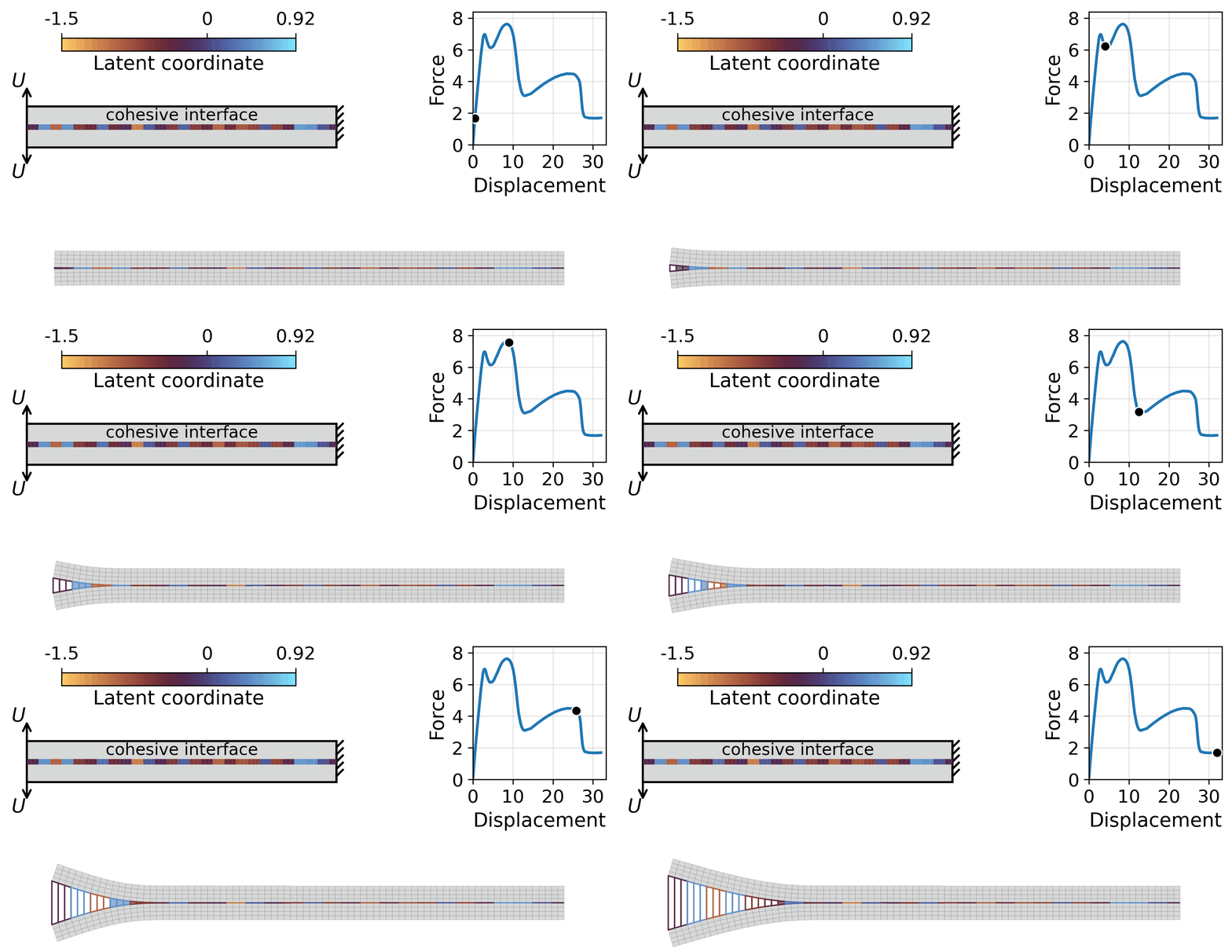
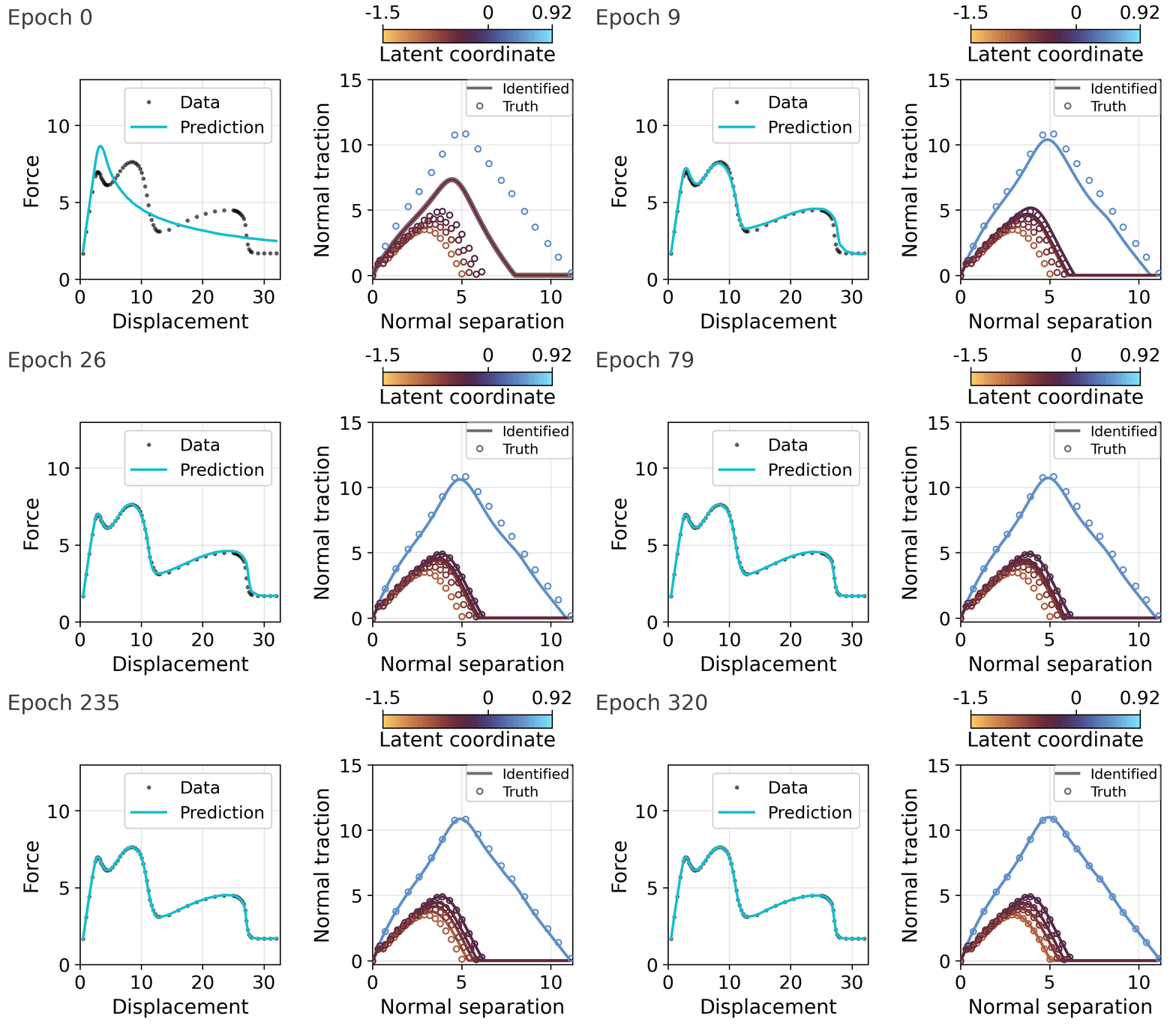
A double-cantilever beam whose interface carries a spatially varying latent coordinate serves as the first test: the cohesive laws are identified from the force-displacement response and DIC strain data.
Fiber-Matrix Composite
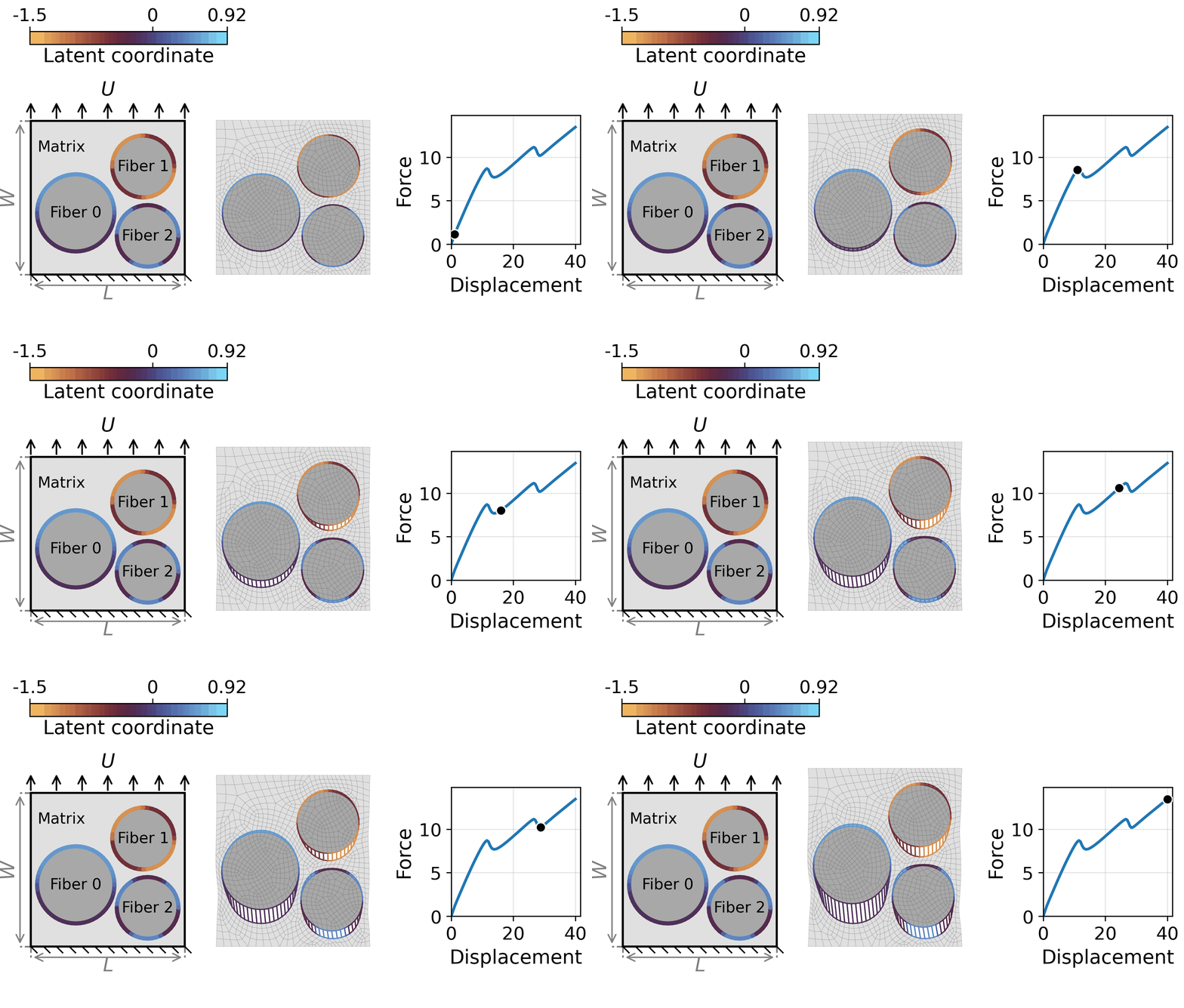
A three-fiber composite with heterogeneous fiber-matrix interfaces extends the test to mixed-mode debonding, where both the Mode I and Mode II traction-separation laws are identified.
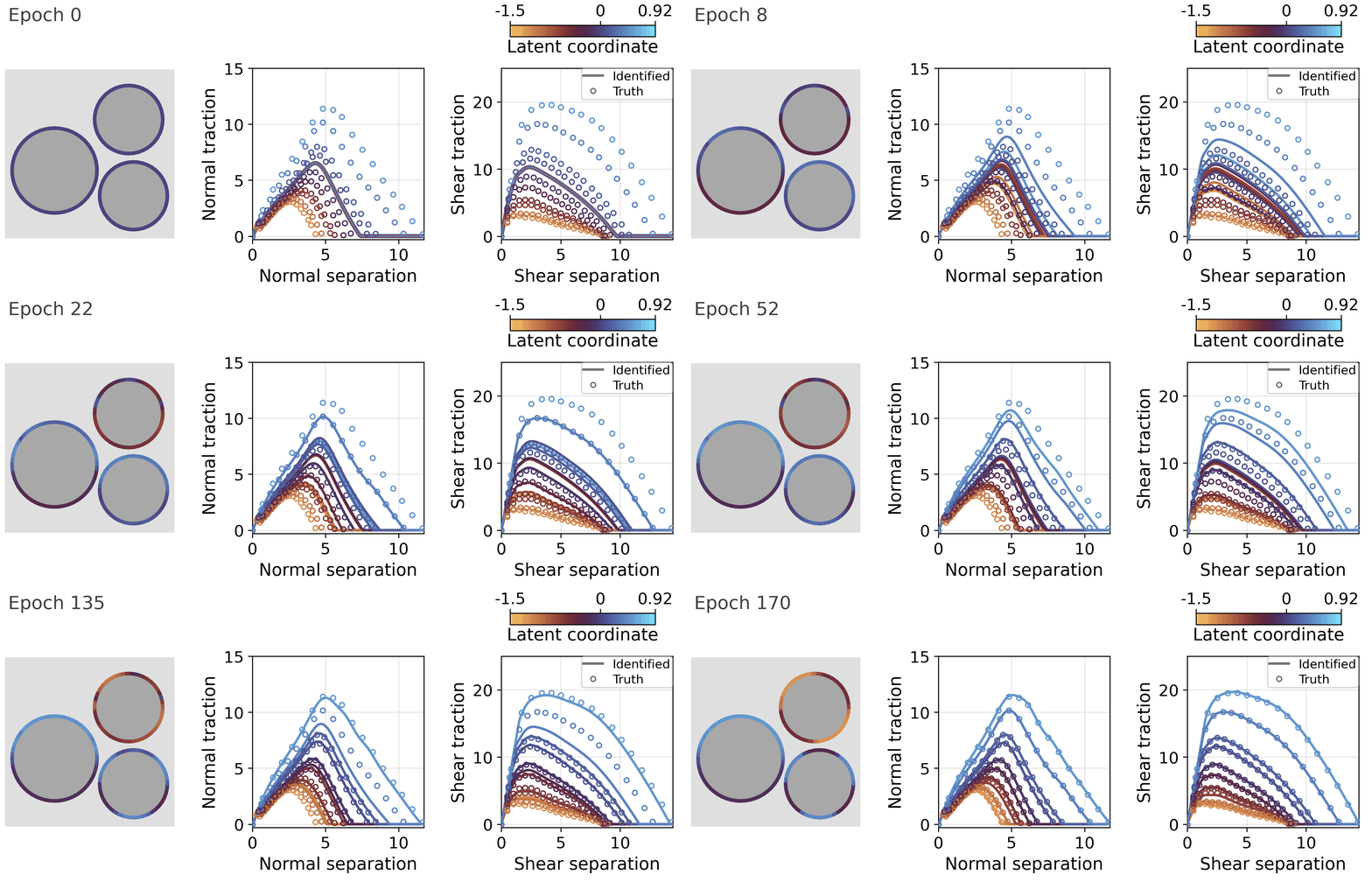
Key Features
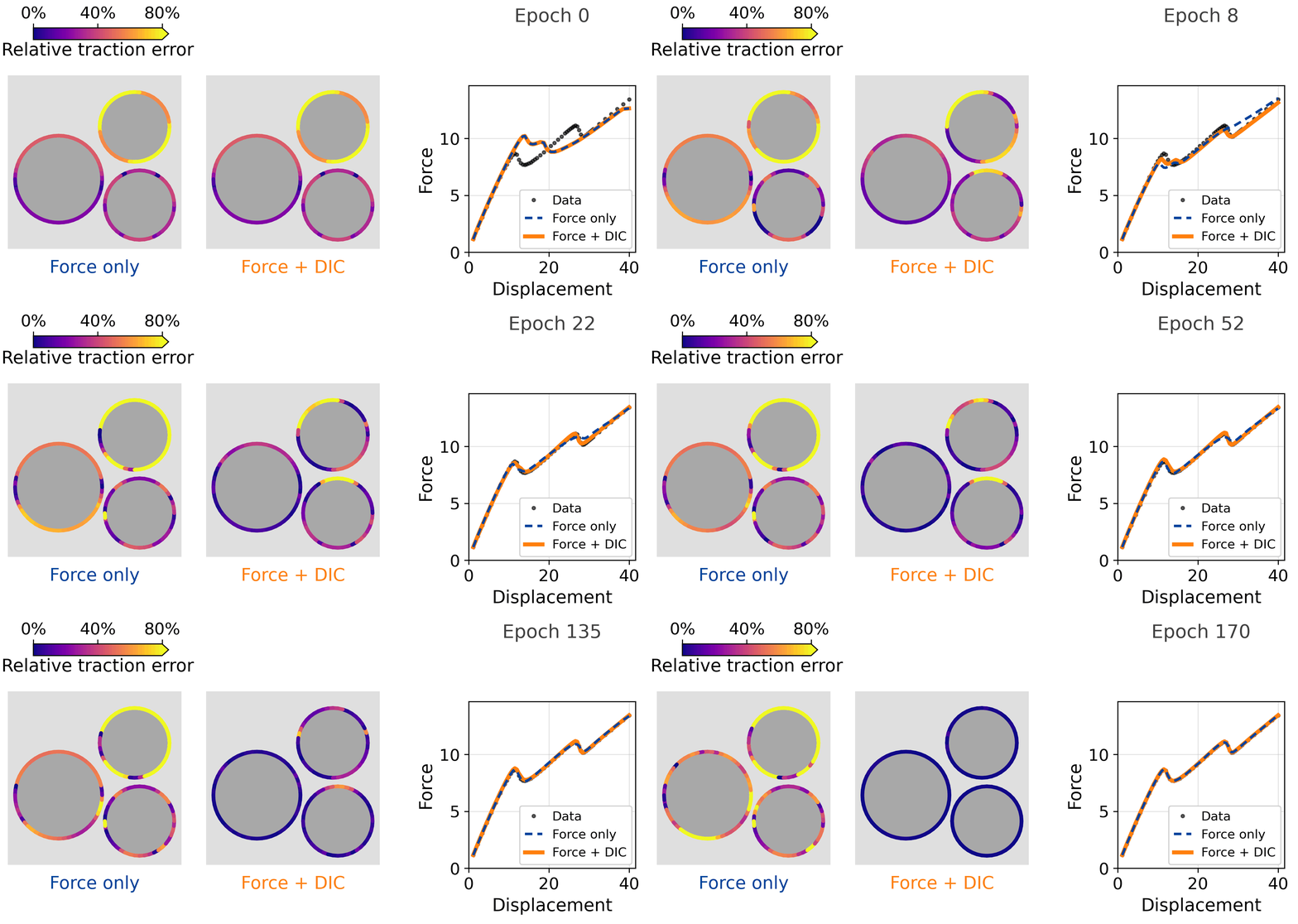
Local measurements matter. Reproducing the global force-displacement response does not by itself guarantee that the true cohesive laws are recovered. Adding spatially resolved strain measurements, such as digital image correlation (DIC), substantially improves identification.
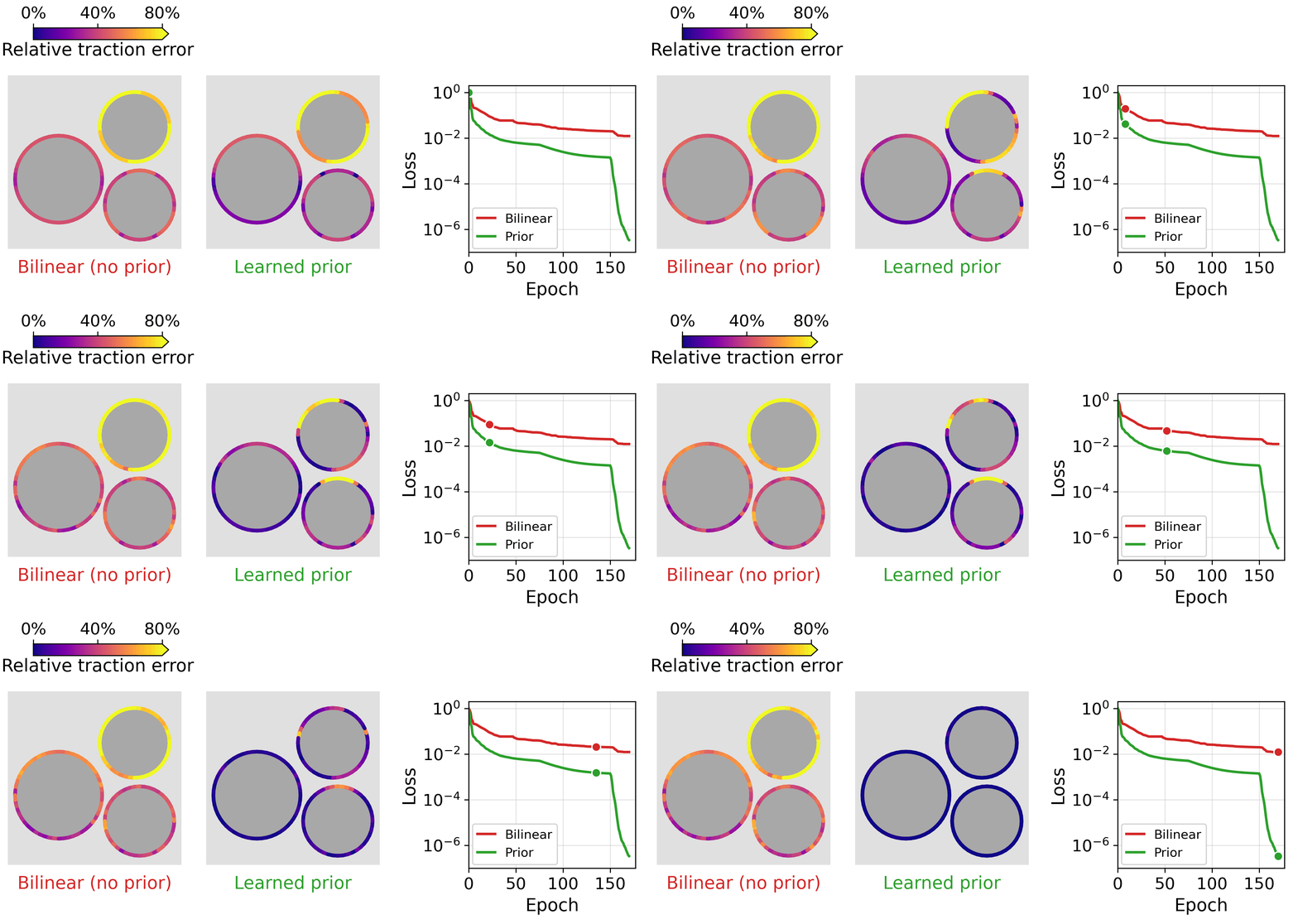
Beyond classical cohesive laws. The learned constitutive prior overcomes the representational limits of conventional cohesive models, even when their parameters are allowed to vary spatially.
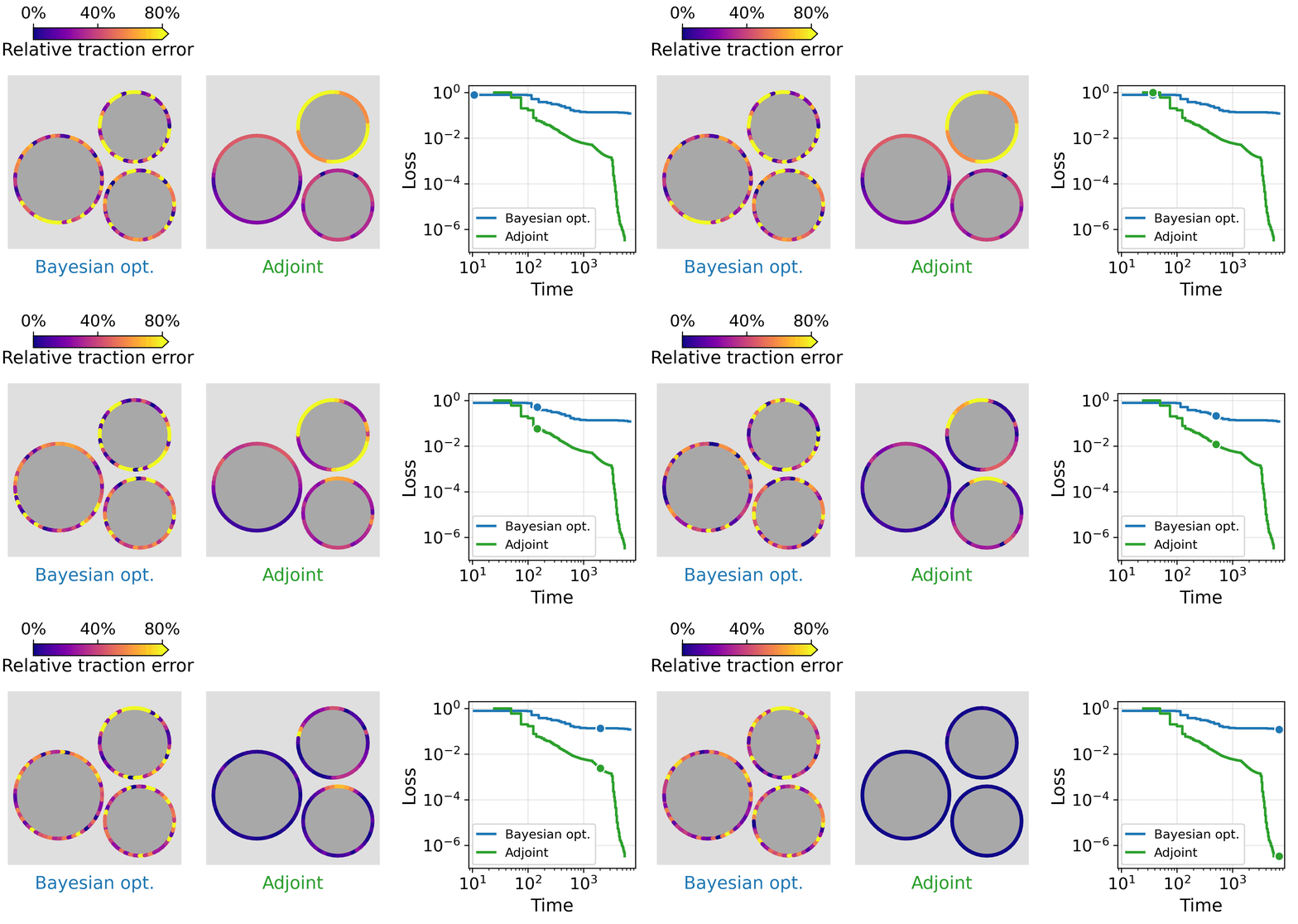
Efficient inverse identification. The intrinsic cohesive finite element formulation is fully differentiable, so sensitivities come from a discrete adjoint that accounts for the history-dependent evolution of interfacial damage. In high-dimensional inverse problems, this adjoint-based identification outperforms derivative-free Bayesian optimization.